


When world financial leaders meet in Singapore this month for the joint World Bank/IMF meetings, they must confront one singularly important question: Is there any way to coax the IMF's largest members -- especially the US and China -- to help diffuse the risks posed by the world's massive trade imbalances?
This year, it is expected that the US will borrow roughly US$800 billion to finance its trade deficit. Incredibly, the US is now soaking up roughly two-thirds of all global net saving, a situation without historical precedent.
While this borrowing binge might end smoothly, as US Federal Reserve Chairman Ben Bernanke has speculated, most world financial leaders are rightly worried about a more precipitous realignment that might set off a massive dollar depreciation and possibly much worse. Indeed, if policymakers continue to sit on their hands, it is not hard to imagine a sharp global slowdown or even a devastating financial crisis.
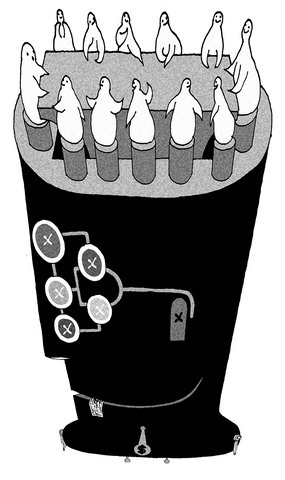
Although Bernanke is right to view a soft landing as the most likely outcome, common sense would suggest agreeing on some prophylactic measures, even if this means that the US, China and other large contributors to the global imbalances have to swallow some bitter medicine.
Unfortunately, getting politicians in the big countries to focus on anything but their own domestic imperatives is far from easy.
Though the comparison is unfair, it is hard not to recall the old quip about the IMF's relative, the UN: "When there is a dispute between two small nations, the UN steps in and the dispute disappears. When there is a dispute between a small nation and a large nation, the UN steps in and the small nation disappears. When there is a dispute between two large nations, the UN disappears."
Fortunately, the IMF is not yet in hiding, even if some big players really don't like what it has to say.
The IMF's head, Rodrigo Rato, rightly insists that China, the US, Japan, Europe and the major oil exporters -- now the world's biggest source of new capital -- all take concrete steps toward alleviating the risk of a crisis.
Though the exact details remain to be decided, such steps might include more exchange-rate flexibility in China, and perhaps a promise from the US to show greater commitment to fiscal restraint.
Oil exporters could, in turn, promise to increase domestic consumption expenditure, which would boost imports.
Likewise, post-deflation Japan could promise never again to resort to massive intervention to stop its currency from appreciating. Europe, for its part, could agree not to shoot its recovery in the foot with ill-timed new taxes such as those that Germany is contemplating.
Will the IMF be successful in brokering a deal? The recent catastrophic collapse of global trade talks is not an encouraging harbinger. Europe, Japan and (to a much lesser extent) the US were simply unwilling to face down their small but influential farm lobbies. The tragic result is that some of the world's poorest countries cannot export their agricultural goods -- one of the few areas where they might realistically compete with the likes of China and India.
Fortunately for Rato, addressing the global imbalances can be a win-win situation. The same proposed policies for closing global trade imbalances also, by and large, help address each country's domestic economic concerns.
For example, China needs a stronger exchange rate to help curb manic investment in its export sector, and thereby reduce the odds of a 1990s-style collapse. As for the US, a sharp hike in energy taxes on gasoline and other fossil fuels would not only help improve the government's balance sheet, it would also be a way to start addressing global warming. What better way for new US Treasury Secretary Hank Paulson, a card-carrying environmentalist, to make a dramatic entrance onto the world policy stage?
Similarly, the technocrats at the Bank of Japan surely realize that they could manage the economy far more effectively if they swore off anachronistic exchange-rate intervention techniques and switched wholeheartedly to modern interest-rate targeting rules such as those used by the US Federal Reserve and the European Central Bank.
With Europe in a cyclical upswing, tax revenues should start rising even without higher tax rates, so why risk strangling the continent's nascent recovery in the cradle? Saudi Arabia, with its burgeoning oil revenues, could for its part use a big deal to reinforce the country's image as a major anchor of global financial stability.
If today's epic US borrowing does end in tears, and if world leaders fail to help the IMF get the job done, history will not treat them kindly. Instead, they will be blamed for not seeing an impending catastrophe that was staring them in the face. Let's hope that on this occasion in international diplomacy, the only thing that disappears are the massive global trade imbalances, and not the leaders and institutions that are supposed to deal with them.
Kenneth Rogoff is professor of economics and public policy at Harvard University, and was chief economist at the IMF.
Copyright: Project Syndicate
The conflict in the Middle East has been disrupting financial markets, raising concerns about rising inflationary pressures and global economic growth. One market that some investors are particularly worried about has not been heavily covered in the news: the private credit market. Even before the joint US-Israeli attacks on Iran on Feb. 28, global capital markets had faced growing structural pressure — the deteriorating funding conditions in the private credit market. The private credit market is where companies borrow funds directly from nonbank financial institutions such as asset management companies, insurance companies and private lending platforms. Its popularity has risen since
The Donald Trump administration’s approach to China broadly, and to cross-Strait relations in particular, remains a conundrum. The 2025 US National Security Strategy prioritized the defense of Taiwan in a way that surprised some observers of the Trump administration: “Deterring a conflict over Taiwan, ideally by preserving military overmatch, is a priority.” Two months later, Taiwan went entirely unmentioned in the US National Defense Strategy, as did military overmatch vis-a-vis China, giving renewed cause for concern. How to interpret these varying statements remains an open question. In both documents, the Indo-Pacific is listed as a second priority behind homeland defense and
Every analyst watching Iran’s succession crisis is asking who would replace supreme leader Ayatollah Ali Khamenei. Yet, the real question is whether China has learned enough from the Persian Gulf to survive a war over Taiwan. Beijing purchases roughly 90 percent of Iran’s exported crude — some 1.61 million barrels per day last year — and holds a US$400 billion, 25-year cooperation agreement binding it to Tehran’s stability. However, this is not simply the story of a patron protecting an investment. China has spent years engineering a sanctions-evasion architecture that was never really about Iran — it was about Taiwan. The
In an op-ed published in Foreign Affairs on Tuesday, Chinese Nationalist Party (KMT) Chairwoman Cheng Li-wun (鄭麗文) said that Taiwan should not have to choose between aligning with Beijing or Washington, and advocated for cooperation with Beijing under the so-called “1992 consensus” as a form of “strategic ambiguity.” However, Cheng has either misunderstood the geopolitical reality and chosen appeasement, or is trying to fool an international audience with her doublespeak; nonetheless, it risks sending the wrong message to Taiwan’s democratic allies and partners. Cheng stressed that “Taiwan does not have to choose,” as while Beijing and Washington compete, Taiwan is strongest when


 RSS
RSS